


Description
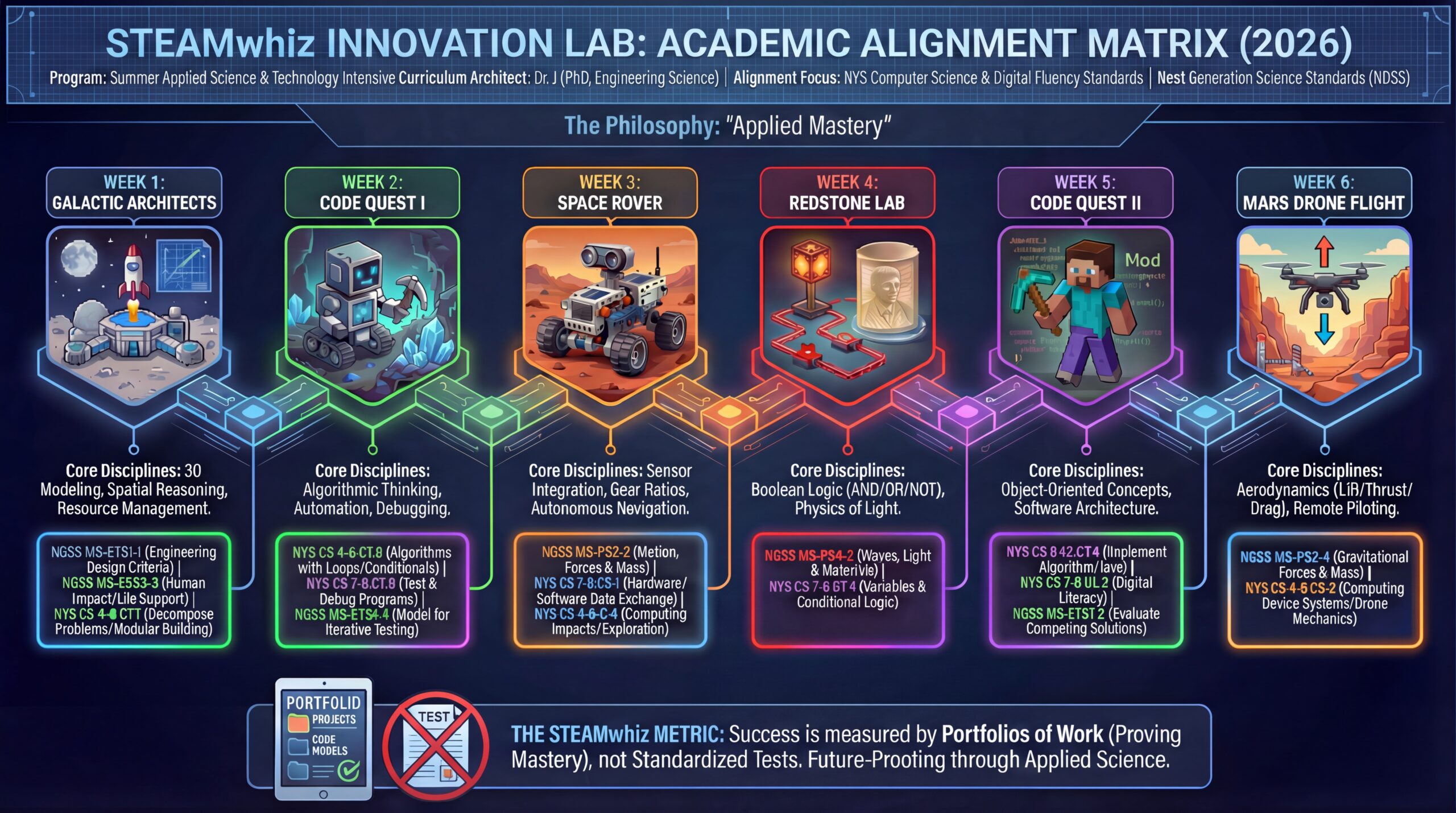
Galactic Architects
Minecraft & 3D Printing Mission
Ages 9-13
June 29 – July 3

Challenge
Blast off on the adventure of a lifetime inspired by NASA’s real-world Artemis
missions! Your challenge is to join a crew, take a rocket to the moon, and
establish a permanent lunar presence. Inside the simulation, you will
experience low gravity, collect rare lunar materials, and face off against
harsh conditions to build your very own lunar outpost. But the mission doesn’t
stop on the screen—you must take your digital blueprints and transform them
into physical reality. Using 3D modeling tools, can you design modular habitat
pods and airlocks that print perfectly and snap together to form a
life-sustaining colony? This adventure invites you to bridge the gap between a
lunar survival game and real-world aerospace engineering.
Project Highlights
Minecraft: Artemis: Moon Base One (Rocket Launch & Lunar Outpost)
Real World: Tinkercad “Modular Mars Base” (Designing Connecting Pods)
Learning Objectives
3D Modeling for Engineering
- Objective: Master computer-aided design (CAD) tools like Tinkercad to create complex, interlocking 3D parts rather than simple shapes.
- Outcome: Create a physical, modular model that accounts for real-world physics, measurements, and 3D print tolerances.
Sustainable Habitat Design
- Objective: Analyze the requirements for human survival in low-gravity environments—such as oxygen generation and radiation protection—using Minecraft’s NASA-inspired simulation.
- Outcome: Apply architectural principles to design a functional base layout that includes specific zones for airlocks, laboratories, and living quarters.
Digital-to-Physical Prototyping
- Objective: Understand the professional workflow of taking a digital concept (your Minecraft Outpost), slicing it for production, and manufacturing a physical object.
- Outcome: Successfully print and assemble a prototype, evaluating how digital geometry translates into physical plastic and iterating on the design if parts don’t fit.
Coding In Space
Galaxy Scavenger
Ages 9-13
July 6 – 10

Challenge
You have been recruited as a Lead Software Engineer for a deep-space exploration team! Your challenge is to program “The Agent,” an autonomous AI robot, to survive and work on hazardous planets where humans cannot go. Instead of manually breaking blocks, you must write complex code to automate resource harvesting across the solar system. Can you write algorithms to detect and mine Blue Ice on Mercury, filter precious metals from Saturn’s rings using advanced logic, and debug the glitched systems of a crashed rover on Mars? This is not just about digging holes; it’s about creating smart systems. Then, you will test your physics knowledge in Scratch by building a “Galaxy Scavenger” game, coding a drone to drift through zero-gravity asteroid fields while managing fuel levels.
Projects Highlights
- Minecraft: “Agent Solar System Tour” (Programming AI for Mining & Repair Missions)
- Real World: Scratch “Galaxy Scavenger” (Building a Physics-based Space Survival Game)
Learning Objectives
Algorithmic Thinking & Automation
- Objective: Learn to automate repetitive tasks by writing programs that use While Loops and Conditionals to detect specific environmental blocks.
- Outcome: Successfully code the Agent to autonomously scan terrain and collect specific resources like Blue Ice and Magma without player intervention.
Debugging & Problem Solving
- Objective: Analyze existing broken code sequences to identify logic errors and “bugs” that stop a program from running.
- Outcome: Fix the corrupted code on the Moon and Mars mission levels to repair broken rovers and retrieve lost samples.
Boolean Logic (Advanced Decision Making)
- Objective: Understand complex decision-making using Boolean operators (AND, OR, NOT) to filter data.
- Outcome: Write sophisticated code for the Saturn and Ganymede missions that filters which rock samples the Agent should keep and which it should discard based on multiple criteria.
Space Rover
Build to Rome
Ages 9-13
July 13 -17
Challenge
How do you explore a planet millions of miles
away without ever stepping foot on it? Your challenge is to become a Robotics
Engineer and master the art of remote exploration. In Minecraft, you will
transport to a digital alien landscape to conduct a critical scouting mission.
You must analyze the terrain and engineer a rover concept capable of handling
the hazardous environment. Whether it’s navigating steep craters or identifying
resource deposits, your strategic planning in the simulation is the key to
success. Then, you will bring that technology to life in the lab. Using Technic bricks, smart motors, and micro-controllers,
you will build a functional, physical robot. But you can’t just drive it with a
remote! You must code it to be autonomous—using
ultrasonic sensors to “see” walls and make split-second decisions to
steer around them.
Project Highlights
- Minecraft: “Planetary Mission Simulation” (Terrain Analysis & Rover Deployment)
- Real World: Technic Brick Smart Rover (Coding an Obstacle-Avoiding Robot)
Learning Objectives
Autonomous Navigation
- Objective: Understand the difference between remote control and autonomous robotics by programming physical sensors to make decisions.
- Outcome: Write code using conditional logic (If/Else) that allows the physical Technic rover to detect an obstacle, stop, and turn to find a new path without human help.
Mechanical Engineering
- Objective: Explore the physics of movement, including gear ratios, torque, and structural integrity when building with Technic bricks.
- Outcome: Construct a sturdy physical rover chassis that supports the weight of the “brain” (micro-controller) and motors while moving smoothly across the floor.
Environmental Analysis
- Objective: Apply engineering logic to survey a 3D digital environment (Minecraft) and determine the necessary requirements for a vehicle to survive there.
- Outcome: Successfully identify hazards in the game world (like lava, steep cliffs, or water) and explain how specific rover features (like tracks vs. wheels) would overcome them.
Redstone Lab
3D Printing & Circuitry
Ages 9-13
July 20 – 24

Challenge
In the depths of space, light is more than just visibility—it is survival. Your challenge is to become a Systems Engineer for a deep-space colony where power is scarce and the nights are long. In Minecraft, you must master the flow of energy using Redstone. Your mission is to design and wire the critical systems of a space base, creating automated lighting and power grids that react to the environment. Then, you will transport this concept of “hidden energy” into the real world. Using advanced 3D printing techniques, you will engineer a “Light Artifact”—a mysterious object that looks solid on the outside but reveals hidden designs and data when illuminated from within. Can you master the physics of light and shadow to create something truly brilliant?
Project Highlights
- Minecraft: “Space Base Power Grid” (Designing Automated Redstone Systems)
- Real World: “3D Printed Light Artifacts” (Engineering Translucent Lithophanes)
Learning Objectives
Systems Logic (Redstone)
- Objective: Understand how to manage the flow of power and signals to create automated machinery.
- Outcome: Construct a functional circuit in Minecraft that solves a specific engineering problem—like emergency lighting or security doors—without manual switches.
Physics of Light (Translucency)
- Objective: Explore how material thickness affects light transmission and how 3D printers can manipulate density.
- Outcome: Design a physical 3D object that utilizes varying layers of plastic to control how light passes through it, creating a “glowing” visual effect.
Engineering Design Process
- Objective: Connect the digital concept of “Input and Output” to real-world fabrication.
- Outcome: Prototype a device that combines a physical shell (3D print) with an energy source (Light) to serve a functional or aesthetic purpose.
Minecraft Modding
SciFi Gadgets
Ages 9-13
July 27 – 31

Challenge
Standard-issue equipment just doesn’t cut it on an alien planet. Your challenge is to join the “Xeno-Tech R&D Division” and invent the next generation of sci-fi survival gear. Using MCreator, a powerful software development environment, you will step behind the curtain of Minecraft’s code to build your own real, installable mods. You aren’t just changing colors; you are programming new logic. Can you code a “Multi-Tool” that defies the laws of physics—perhaps a blaster that levitates enemies, a drill that melts rock instantly, or boots that freeze water into bridges? Once your prototype is coded, you must deploy it into a high-security Minecraft testing facility. Your mission: debug your invention and prove it is ready for deep-space exploration.
Project Highlights
- Real World (Software): “The Exoplanet Multi-Tool” (Designing & Coding a Custom Mod)
- Minecraft: “The Xeno-Testing Facility” (A High-Security Lab for Testing Prototypes)
Learning Objectives
Java Modding Concepts
- Objective: Understand the structure of a Minecraft mod, including textures, item properties, and events.
- Outcome: Successfully compile a functional mod file that introduces a completely new item into the game with custom artwork and stats.
Event-Based Logic (Procedures)
- Objective: Learn to write “Event Handlers”—code that triggers only when a specific action happens (e.g., “When Right-Clicked” — “Spawn Lightning”).
- Outcome: Create a custom “Procedure” in MCreator that gives their tool a special ability, using conditional logic to determine what happens and when.
Game Balance & Design
- Objective: Explore the concept of “Overpowered” (OP) mechanics and why games need limitations to be fun.
- Outcome: Iteratively test their gadget, adjusting variables like “Durability,” “Cooldown,” and “Damage” to ensure the tool is powerful but fair within the game.
Mars Drone Flight
Project Ingenuity
Ages 9-13
August 3 – 7

Challenge
The rover is stuck, and the terrain ahead is unknown. Your challenge is to take to the skies as a pilot for the “Ingenuity” Mars Helicopter division. On the Red Planet, the atmosphere is thin and the canyons are treacherous—ground view isn’t enough. In Minecraft, you will simulate this aerial mission by donning a flight suit (Elytra) to conduct high-speed Aerial Reconnaissance. You must navigate tight obstacle courses to map safe paths through jagged alien canyons. Then, you will enter the flight deck in the real world. Using programmable drones, you will pilot a physical “Mars Helicopter” through a real-life obstacle course. Can you master the physics of flight—thrust, pitch, and roll—to gather the data needed to save the mission?
Project Highlights
- Minecraft: “Aerial Recon Simulation” (High-Speed Elytra Obstacle Course)
- Real World: “The Ingenuity Mission” (Piloting Drones through Mars Obstacles)
Learning Objectives
Aerodynamics & Flight Physics
- Objective: Understand the forces of flight (Lift, Drag, Thrust, and Gravity) and how they differ between Earth and the thin atmosphere of Mars.
- Outcome: Master the controls of a drone (or flight simulator), adjusting altitude and speed to maintain stability while navigating through physical hoops.
Remote Piloting (Line of Sight)
- Objective: Develop the spatial awareness required to pilot a vehicle remotely, translating 3D movements from a controller to the drone’s perspective.
- Outcome: Successfully fly a drone through a complex “Canyon” obstacle course without crashing, demonstrating precise control and depth perception.
Mission Pathfinding
- Objective: Analyze terrain from an aerial perspective to identify safe routes for ground vehicles.
- Outcome: Run a Minecraft flight simulation to “scout” a map, memorizing the layout of the terrain to guide a team (or rover) through it safely afterwards.


